
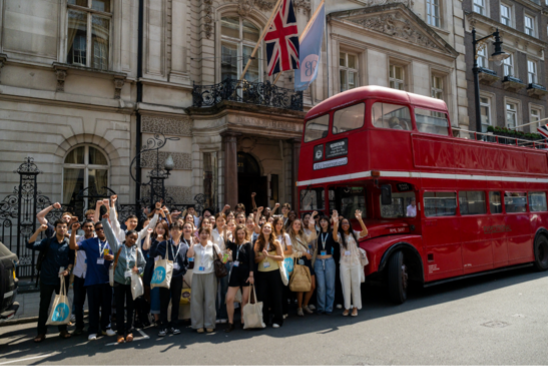
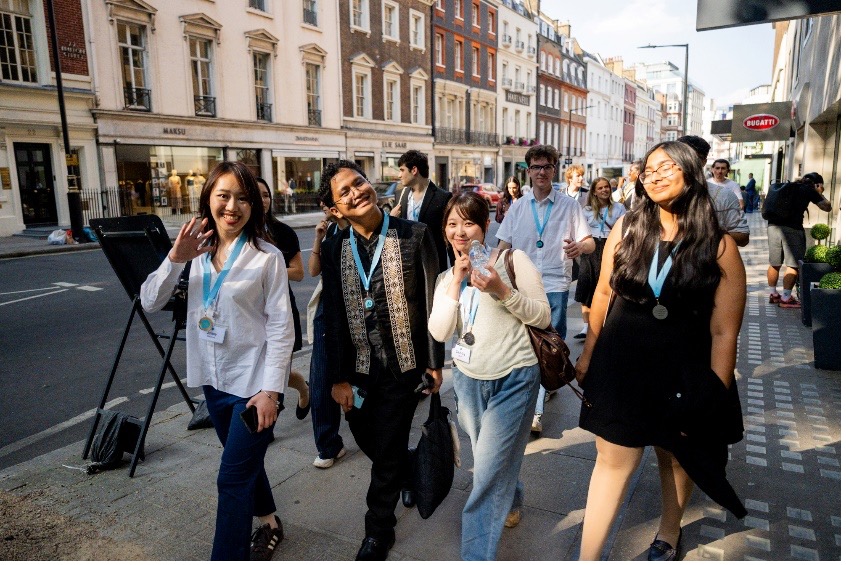
45 candidates from around the world arrived at Dartmouth House at 3pm Monday 13 July and spent the afternoon relaxing and getting to know one another before the Alumni Panel met in the evening to answer any questions they may have had about the competition. The next two days were spent preparing for the competition, socialising, attending coaching sessions with ESU mentors, and visiting tourist attractions around London, including the Tate Modern which they accessed following during an open top bus tour of London.
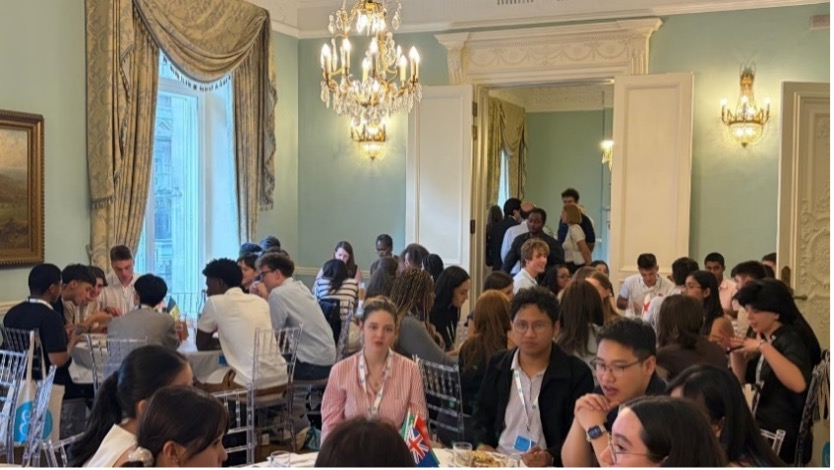
Tuesday morning, the candidates presented their country reports in which they spoke of traditions and features of their homelands, often accompanied by national food delicacies for all to enjoy.
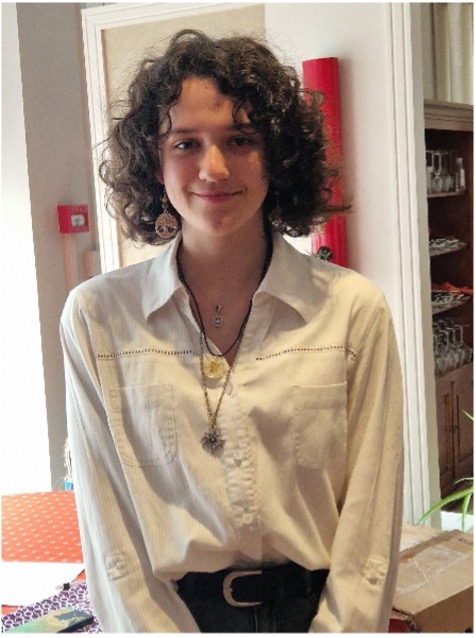
The competition started on Thursday morning with the impromptu speech heats. This involves candidates, selecting a subject from among 3 possible themes and being closely surveyed for 15 minutes whilst preparing a 3-minute speech with only dictionaries to help. The prepared speech heats took place in the afternoon on the theme “The power to question is the basis of all human progress”, words of Indira Gandhi. Our congratulations to the candidate representing France, Norah d’Estève de Pradel Aboki, for a most original approach to her chosen subject.
The 6 finalists were announced Thursday evening: candidates representing Australia, Bermuda, Romania, Serbia, Sri Lanka and Uganda.
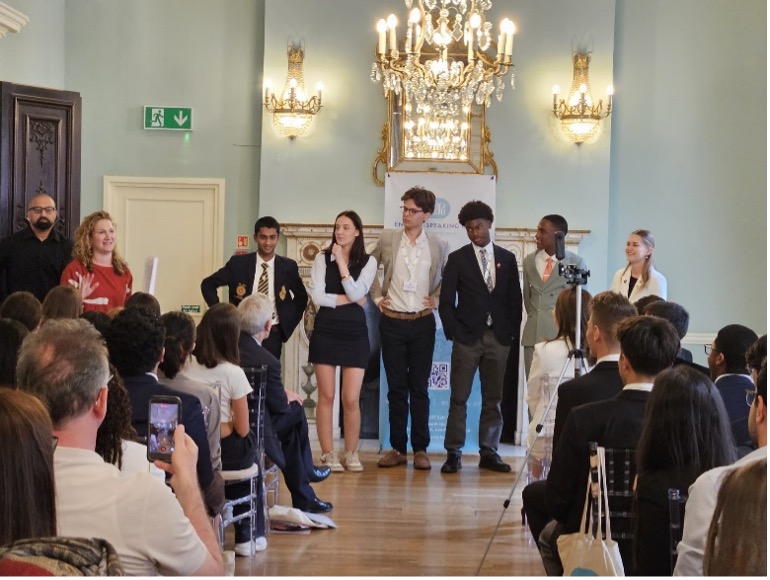
The grand final took place Friday afternoon at the Royal Institution. The finalists presented their speeches on the theme “The light of a candle is transferred to another candle – Spring twilight” a haiku by Japanese poet Yosa Buson. The two Masters of Ceremonies were IPSC alumni from 2024, Mickael Naouri, who represented France and was crowned champion and the runner up, Guilia Chiriac from Romania.
The 5 judges spoke of the high standard of all 6 speeches before declaring Omar Hazari from Sri Lanka the IPSC champion 2026. The runner up was Theodora Todoran from Romania.

Since 1980, The English-Speaking Union (ESU) has organised an international public speaking competition (IPSC) with the goal of nurturing and encouraging the next generation of international communicators and potential social actors. In the words of one participant, quoted on their homepage, ‘Because of IPSC I learned to dream the biggest dreams, and more importantly, to be confident that I’d be able to reach them’.
The human voice, un-amplified by technology, but venerated in its ancient power to share and communicate, is the preferred medium. This potent attribute of the human voice was succinctly expressed by a haiku by Yosa Buson (1716-1784) that served as a departure point for the candidates’ speeches in this year’s competition:
The light of a candle
Is transferred to another candle—
Spring twilight
On 23 May 2026, in the Assemblée Nationale in Paris, a dozen high-school students, who were well-prepared and well-presented, presented one-by-one their offerings to the genius of the voice. Witnessed by the parliamentary assistant, supported by their parents, and grilled by three judges, the students rose to the challenge not only in terms of their speech, but also in the way they answered the questions of the judges.
What makes an effective communicator? As one of the three judges, I had the chance to offer something back to students that I received from others as an adolescent: kind, but analytical commentary on their presentations. My alma mater, Clitheroe Royal Grammar School, provided many opportunities for students to get involved with public speaking and debating. It was therefore with a certain degree of humility that I was able to encourage these young speakers to advance in their works. Much of my professional work in teaching has focused on spoken communication, or as the ESU would put it, oracy. It is the ability to transmit, or transfer, one’s own thoughts to a listener.
Based on what I saw during the competition, and other experiences, I have reflected on what makes an effective communicator. By this, I would like to emphasise the context of transmitting a message in a live context, namely present, spoken and acoustic. I am not talking about social media, podcasts, or other forms of communication that rely on external technology. But rather the skill of promoting dialogue between people themselves to further social and cultural aims; instigating discussion on key topics for progress, both social and technological; and encouraging collaboration, which is the only way we as a species have survived and thrived.
Context
The first point I wish to make is understanding the context in which you are operating. An effective speaker needs to be highly sensitive to the time and space in which they are talking. The way that a teacher addresses their students is not the same as when the teacher addresses their colleagues; many politicians’ gaffs will come from a misunderstanding, or a misreading, of the room. To this effect, speakers who were able to integrate elements of their surroundings effortlessly into their speech were effective. By referring to the room that we were in, pointing out a painting, making eye contact with everyone there, such speakers were present both temporally and spatially. Dress is also part of communication. While students should feel comfortable expressing themselves, a national final held at the Assemblée Nationale is a professional setting, and effective communicators understand that appearance contributes to the first impression they make on an audience.
Defend and criticise
If the first point relates to the form, this second suggestions refers to the substance. Communication needs to defend one position with conviction and criticise another with compassion. If this delicate balance is not met, then it transforms into a more nocive form of expression, that of propaganda or an agenda. In this sense, we are looking for a two-way street: the speaker can present a well-defined position on a subject, but also highlight to their listeners any opposing views. This leads us to understanding what I mean by a well-defined position and it is well worth mentioning that an example is not an argument. While personal anecdotes can help bring a sense of proximity and macro statistics anchor the speech in a broader context, it is necessary to refine and specify argumentation. This also means giving a thrust and a focus to your speech, instead of simply listing a series of facts without narrative or argumentation. Passion and curiosity for a subject are wonderful, but it is the forensics of your structure that will hook your listeners.
You might have delivered a well-prepared speech, but the questions at the end are a moment of improvisation. Pausing before answering, to let the little grey cells do their work, is a great tip. Repeating, or paraphrasing the question at some point (usually the beginning of the answer) can serve as a runway to your comments. Enjoying the challenge of the moment is contagious.
Power of the word
My final point relates to the great power that speakers can wield over their listeners. Students sometimes confused the fine line between a spoken word poem and a speech. The Poetry Foundation gives the following description: “Characterised by rhyme, repetition, improvisation, and word play, spoken word poems frequently refer to issues of social justice, politics, race, and community.” This could very well be the description of a speech. However, while a spoken word piece relies more on the body and the voice and the music, a speech is more focused on the words and the structure; the body and the voice are the medium, not the message.
The strength of a speech will often come from the listener’s belief that the person speaking will lead them to new and exciting places. The power of a great speech is that it makes us dream and imagine new possibilities. We don’t need the spiritual guides of religion to grasp the power that a word has: when we feel sad or scared, a word can uplift and reassure us. Effective communicators, with a certain charm and an ability to persuade, need to be incredibly mindful of the power that they possess. To quote a Hollywood blockbuster, ‘with great power comes great responsibility’. Therefore, pick your words carefully and what you do with them even more so.
Final call
On the day that I was invited to judge the competition for the French national final, I was struck by the words that inspire the country’s main political chambre, the Assemblée Nationale. The words that inspire it are, among others: duties, rights, citizens, social body, talents, expression, opinion, public strength, common good. All of these could fit in with the mission statement of the ESU. A second curiosity came from the fact that it was the weekend of the Pentecost, a moment in the New Testament when the Apostles were invited to spread the positive message across the whole world. Could we hope that these young leaders might be able to share the common good throughout the world for a better future? I am persuaded and convinced.
The NPSC took place in an impressive amphitheatre at the Assemblée Nationale during the afternoon of 23 May 2026.
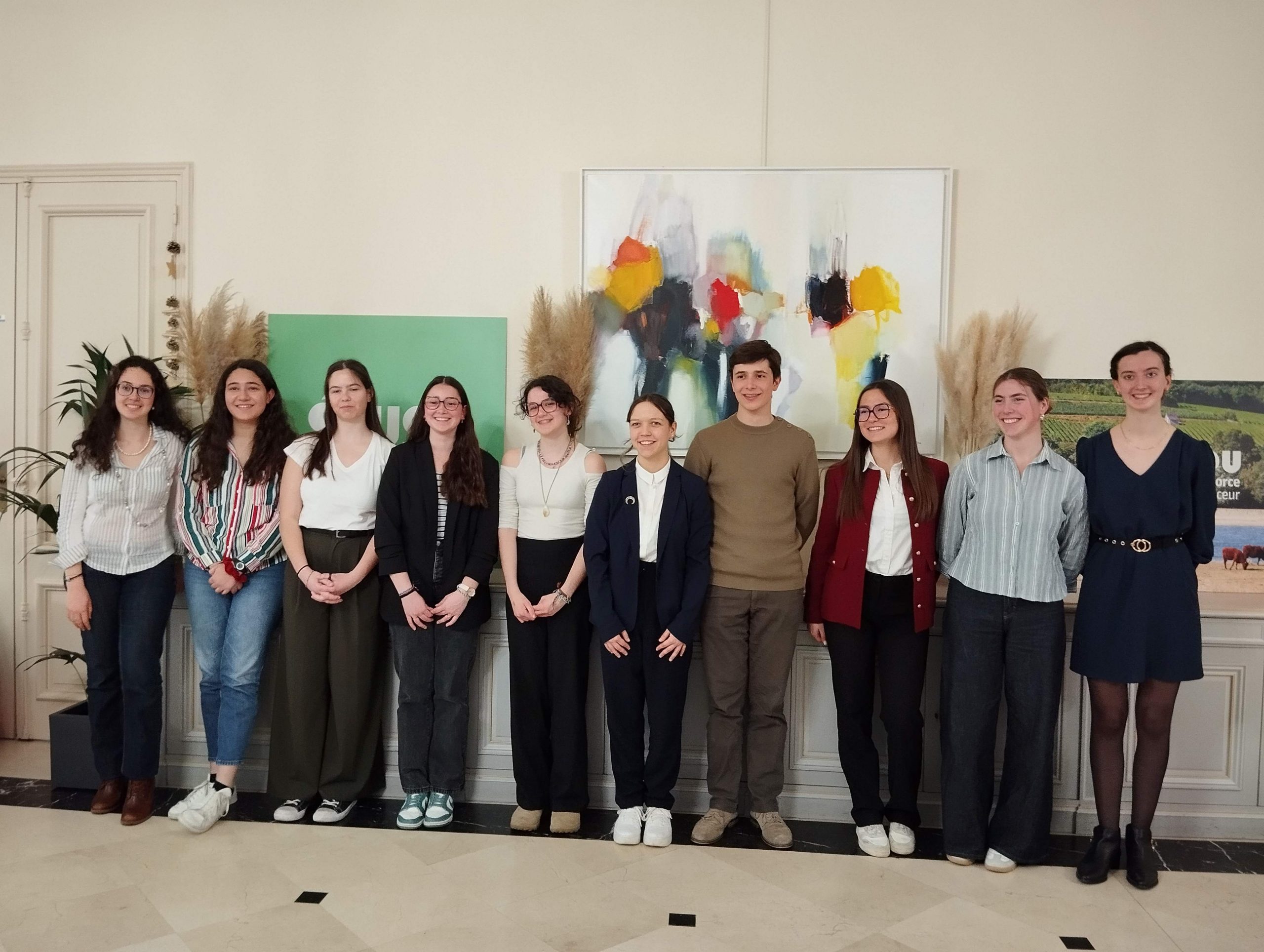
3 candidates had been selected at each regional final in Aix-Marseille, the Loire Valley and Taverny in the Val d’Oise. They were joined by 3 independent candidates from Paris and Strasbourg, making a record number of 12 candidates who delivered their speeches to the jury of 3: Edward Bell, a graduate of Oxford University and former member of the Oxford Union, now a debate coach at ENSTA and a theatre teacher at Télécom Paris, Shanika de Silva, a semi-finalist of the French Debating Association tournament, 2014, currently it’s president, and Colleen Shaughnessy-Larsson, a Distinguished Toastmaster with Toastmasters International who mentors young people in public speaking, meeting management & teamwork.
All candidates performed extremely well despite some difficult questions from the jury. After a short deliberation, the judges selected Norah d’Esteve de Pradel Aboki from Aix-Marseille to represent France at the international competition in London 13 – 18 July. The candidate in second place was also from Aix-Marseille, Rose Yazge, and in third place was Nathaniel Walmsley from Strasbourg.
The theme for the heats in London is a quotation from Indira Gandhi, the first female prime minister of India: “The Power to Question is the basis of all Human Progress”.
All our best wishes go to Norah for success in the international competition, and for an amazing week in London amongst young people from over 40 countries worldwide.
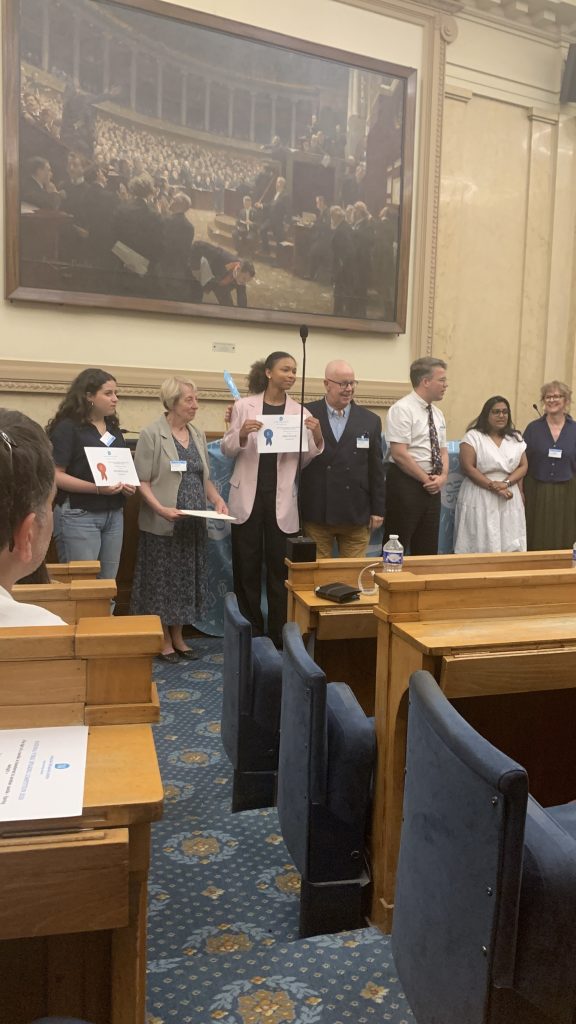
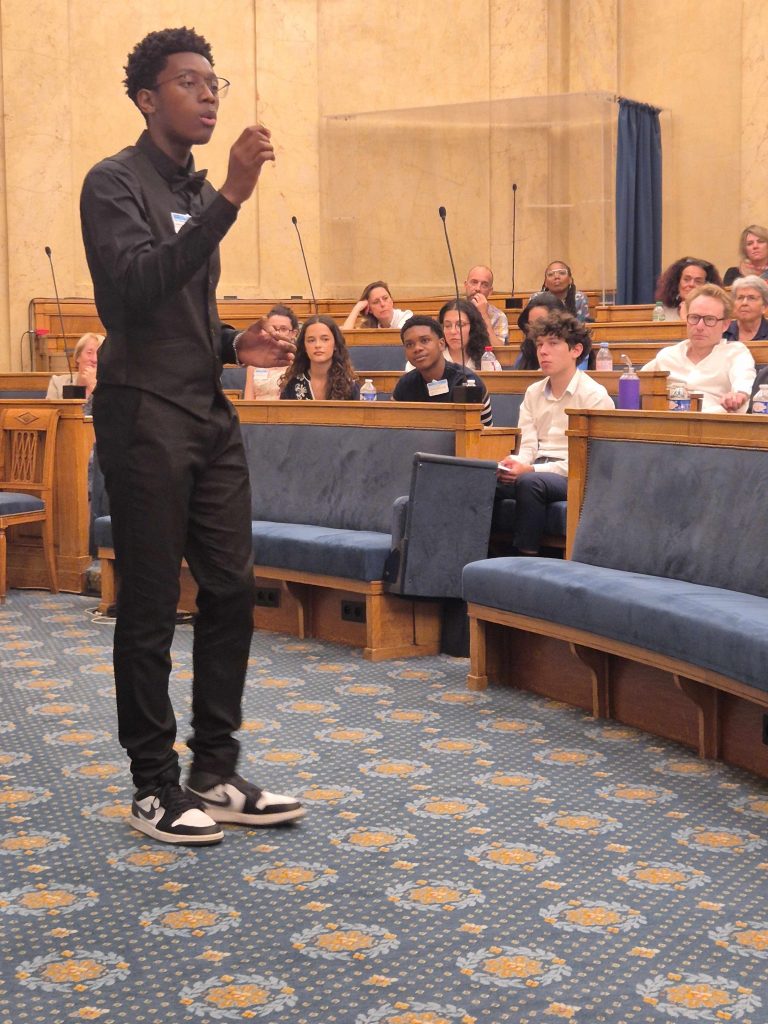
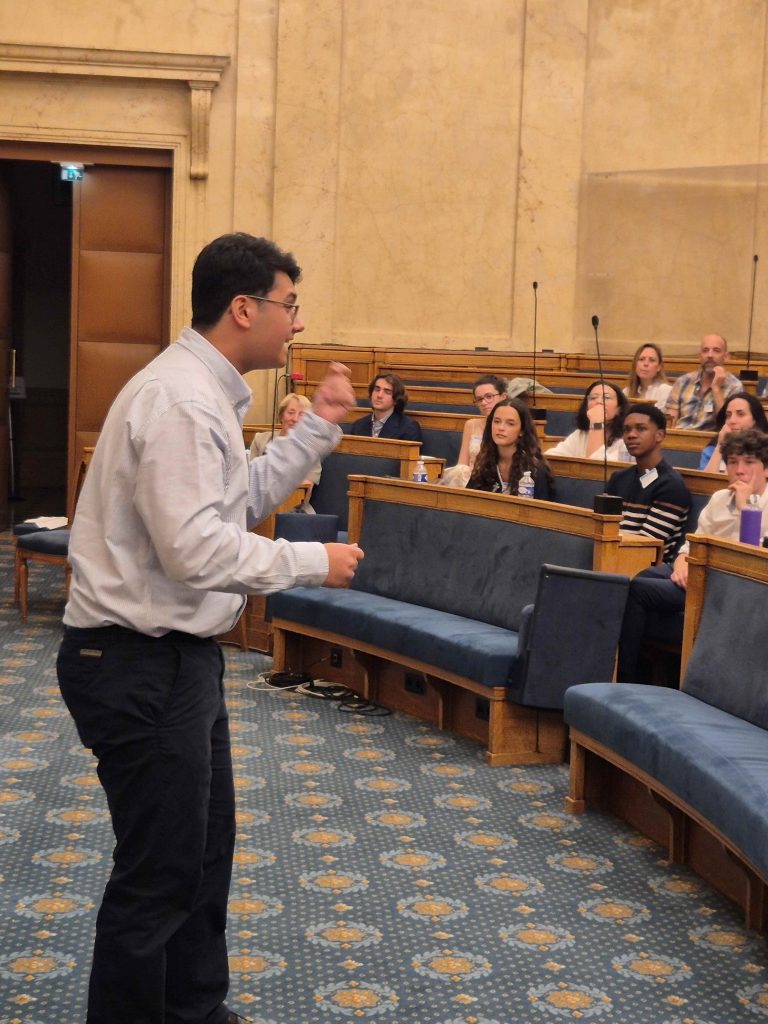
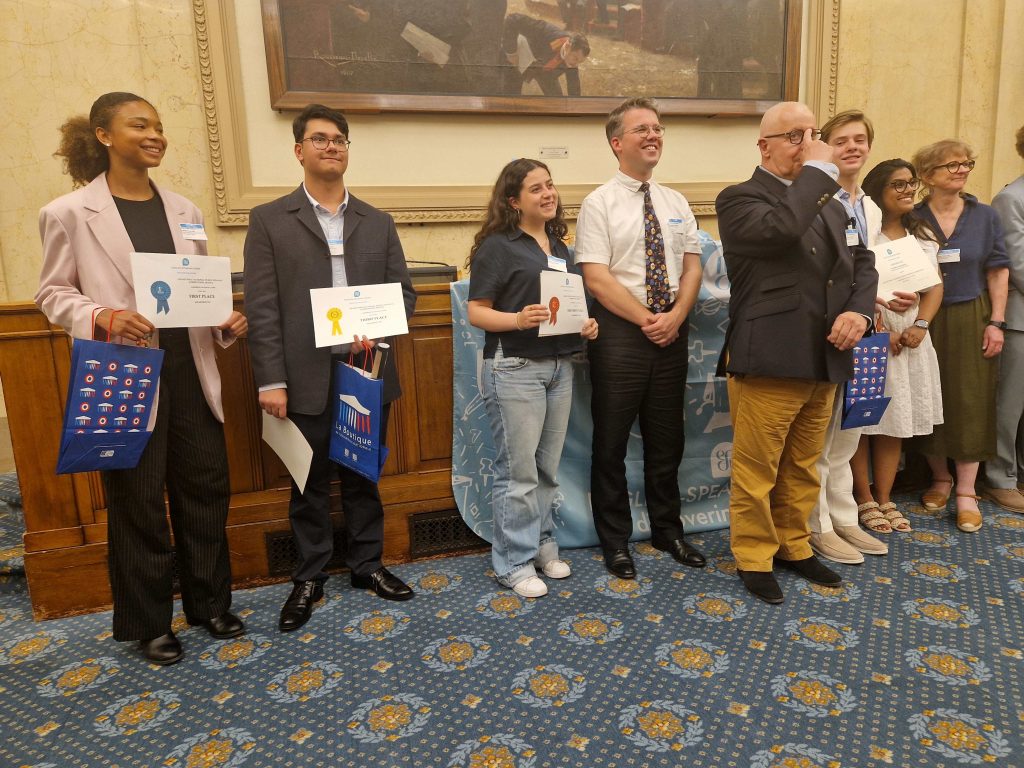
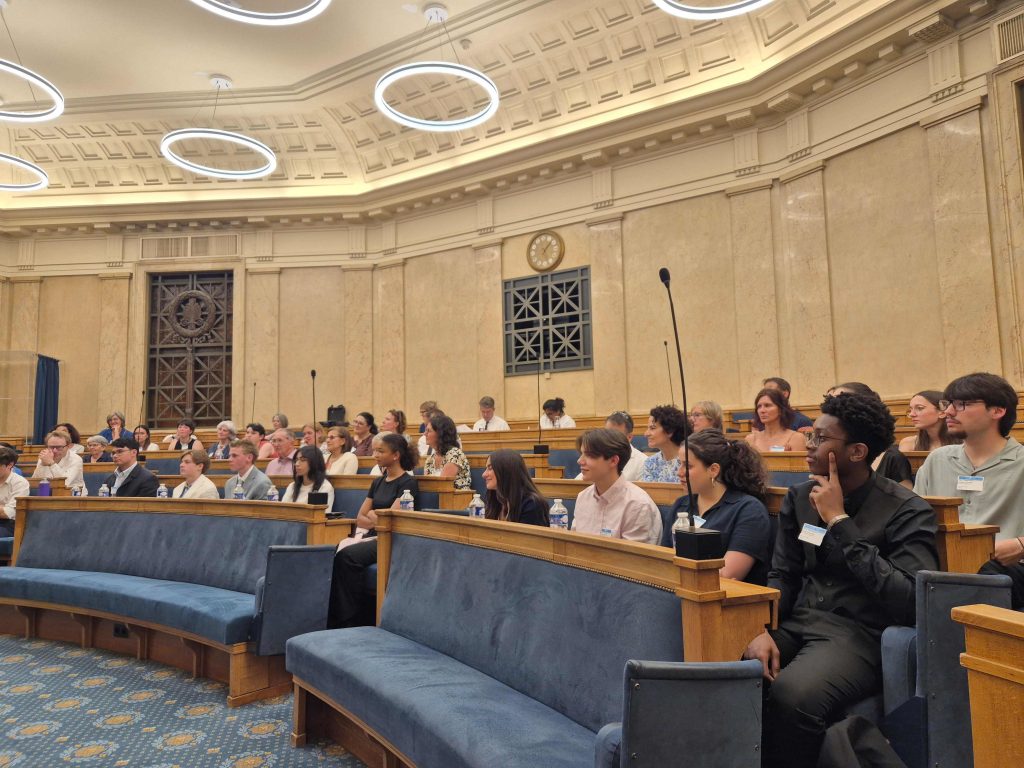
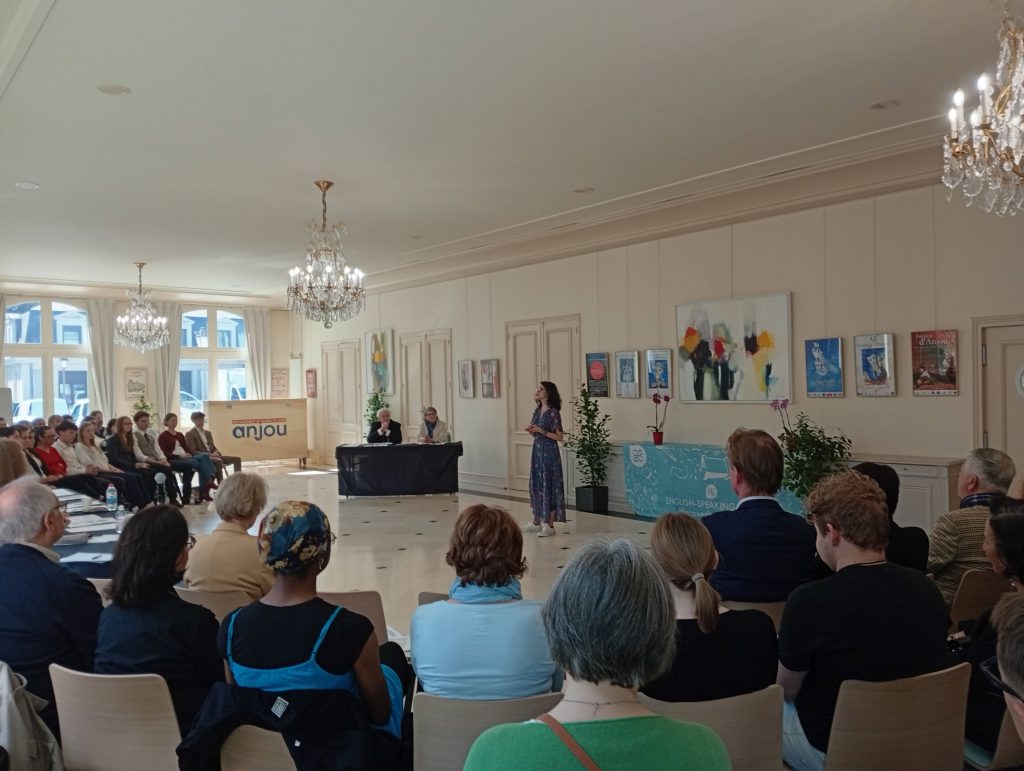
The 2026 Regional Public Speaking Competition in English took place in the Salons de la Présidence at the Préfecture, Place Michel Debré, Angers, during the afternoon of 21 March 2026, when 10 candidates presented their speeches on the theme “The light of a candle is transferred to another candle – Spring twilight”, a haiku called “Lighting One Candle” by Yosa Buson.
The afternoon’s proceedings were introduced by Yann Semler-Collery, Prësident de la Commission Culture du Département de Maine et Loire, a firm supporter of the opportunity the competition opens up to young people. Ilona Marx the took the floor. Ilona represented France at the international finals in London 2025 and spoke with great enthusiasm to the candidates emphasising the success they had already achieved.
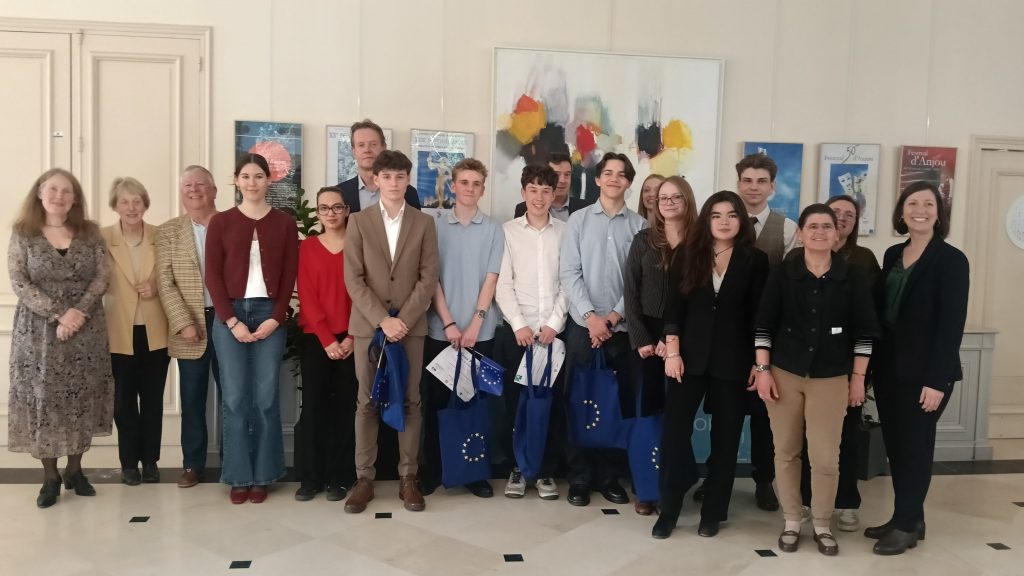
3 candidates were selected by the jury to represent the ESU Loire Valley in the national finals, 23 May, at the Assemblée Nationale in Paris, when a total of 12 candidates will compete from various regions: the Loire Valley, Aix-Marseille, Taverny in the Val d’Oise, Paris and Strasbourg. One will be selected to represent France in London at the ESU international public speaking competition between 13 and 18 July 2026.
Our thanks to Yann Semler-Collery, to the judges and teachers involved and to our partners, the Bibliothèque Anglophone in Angers, and the Maison de l’Europe Maine et Loire – Europe Direct, for their work prior to, and during the competition.
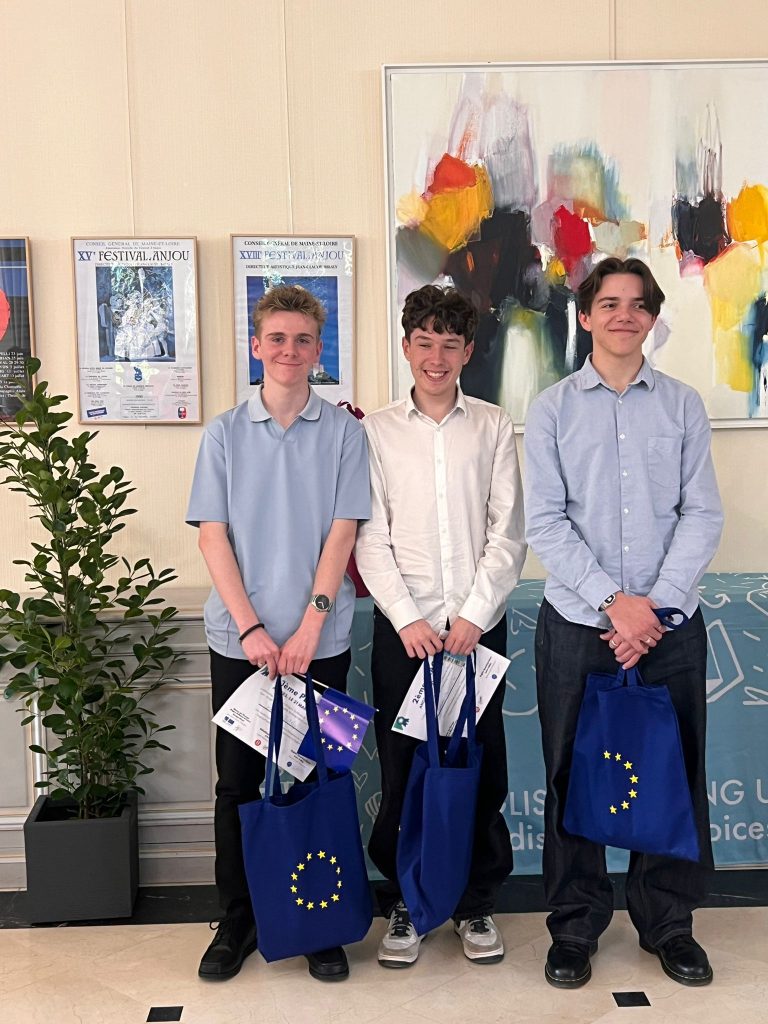


The ESU Loire Valley has been taking part in the ESU International Public Speaking Competition (IPSC) every year since 2012. This competition is the highlight of the ESU international calendar. It is the largest public speaking competition in the world and currently involves over half a million students in more than 50 countries.
It takes place in London in May each year and represents one of the clearest manifestations of the goals of the ESU: to encourage cultural exchange and help young people to become confident communicators.
Alongside visits to London tourist attractions and to the theatre, the organisers work hard to ensure that the candidates experience activities that will enhance their speaking skills and will enable cultural exchange and new friendships to develop between them.
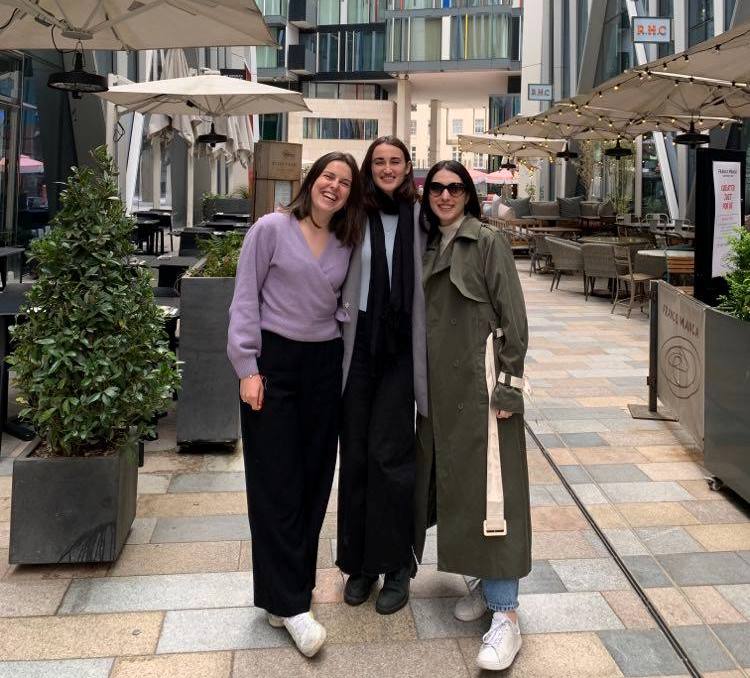
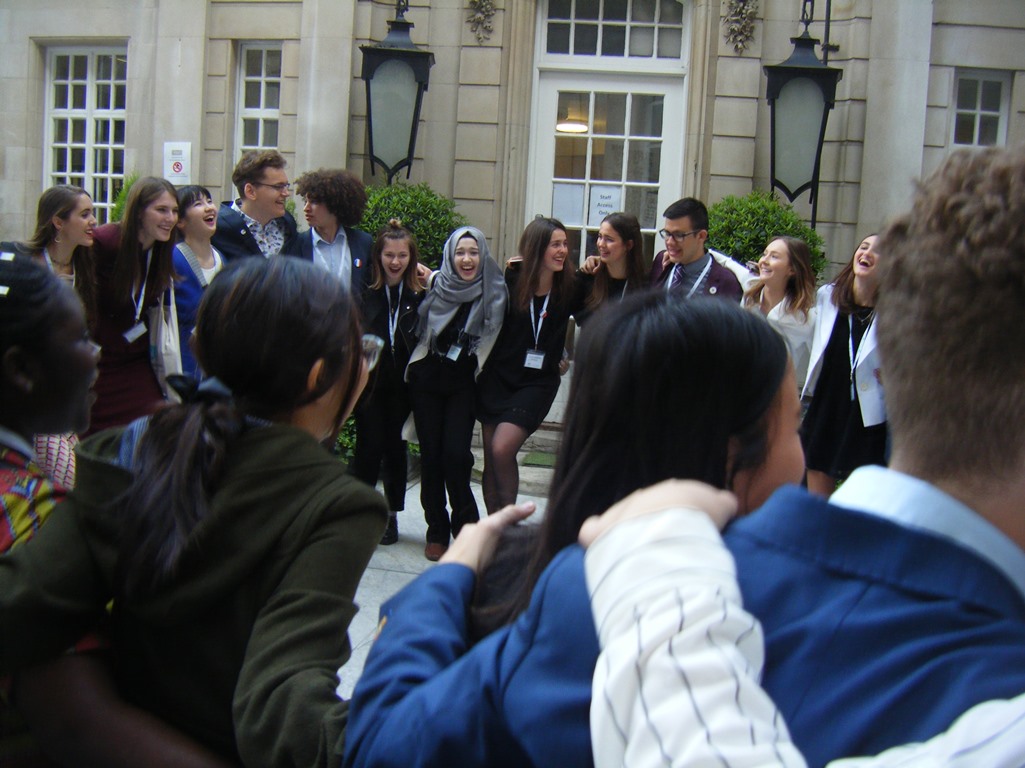
This photograph was taken 24 April 2022, in London, four years after the three young ladies first met when Laure Chabenat, from Fontevraud, represented France, Mariana Levashov-Tumanishvili represented Georgia, and Nicole Camila Kohan represented Argentina, at the International Public Speaking Competition 2018.
To quote Laure, on the left of the photo:
“Even 4 years later it’s like nothing has changed. You can see it in the picture, Argentina, Georgia and France are still getting along as well as ever.
I wish to thank you for the incredible opportunity that was the IPSC. All the training before being selected and then the week in London. It has all been a marvellous journey that truly changed me, and I will forever be grateful.”
To select a candidate to represent France at the IPSC, a Regional Public Speaking Competition (RPSC) is held in Angers every year in March, organized jointly by the ESU Loire Valley, the Bibliothèque Anglophone in Angers, and the Maison de l’Europe Angers et Maine et Loire. Three winning candidates progress to the National Finals in Paris where they compete with students representing ESU Aix-Marseille for the honour of representing France in the International Competition in London in May.


Region Finals
The regional finals took place 15 March 2025 in Angers in the Salons de la Présidence at the Préfecture, for the use of which we are thankful to Yann Semler-Collery, the councillor responsible for culture and heritage in the Maine-et-Loire. The jury of 3 were unanimous in their decision and selected 3 from the 9 candidates present to travel to Paris to represent this region in the national finals: 1 from the Lycée Joachim du Bellay, 1 from the Lycée St. Benoît, both in Angers, and 1 from the Lycée St. Louis in Saumur.
The theme for the regional and national finals 2025 was a line spoken by Ophelia in Shakespeare’s “Hamlet”: “We know what we are but not what we may be”.
National Finals
In Paris, 5 April 2025, the national finals took place in a salon at the Assemblée Nationale. There were 3 candidates from the Loire Valley, 3 from Aix-Marseille and 2 from the Paris region. The judges were Jessica Clements, who is in charge of international programmes at Dartmouth House, Edward Archer, who runs an agency training businesspeople in public speaking, and Michael Naouri, last year’s international competition winner. They were unanimous in their decision, and it will be Ilona Marx, a student at the Lycée Saint Louis in Saumur who will represent France at the international competition in London 12 – 17 May 2025. The candidate in second place was also from our region: Lilou Rey-Grobellet, a student at the Lycée Joachim du Bellay, who came 1st at the regional competition in Angers.
The theme for the heats in London 2025 is a quotation from Mahatma Gandhi : “Unity to be real must stand the severest strain without breaking”.


The National Public Speaking Competition 2025 took place in the Salons at the Assemblée Nationale, Paris, during the afternoon of Saturday 5 April 2025.
Ilona has since spoken to the ESU Loire Valley members of her experience attending the international finals in London last May when around 40 young people spent a week together, honing their public speaking skills, sightseeing and socialising as well as competing for the international title. Ilona remains in touch with her many new friends and describes the weeklong stay as ‘lifechanging’.
We would love to hear from teachers interested in assisting their students aged between 16 – 20 years to prepare for this competition, and also from individuals who may be able to contribute to developing the skills and confidence that will be vital to our young in their future careers.
We would be delighted to welcome you on board this truly rewarding project.
If you would like extra details, please contact president@esu-loire-valley.fr